Εμφάνιση αναρτήσεων με ετικέτα BREAST CANCER. Εμφάνιση όλων των αναρτήσεων

Τετάρτη 6 Ιανουαρίου 2021

SURGERY FOR METASTATIC BREAST CANCER?

 Surgery, in addition to treatments like chemotherapy and radiation therapy, may improve survival for certain patients with metastatic breast cancer. A research team studied nearly 13,000 patients with stage IV disease and found that those who had surgery in addition to other treatments had a survival advantage over those who had other treatments alone. These findings were published by Stahl et al in Annals of Surgical Oncology.

Stage IV breast cancer accounts for 6% of newly diagnosed breast cancer cases. Systemic therapy, which may include treatments like chemotherapy, hormone therapies, and immunotherapies, is routinely part of treatment plans for those patients. The benefits of surgery to remove the primary breast cancer are currently only recommended for relieving symptoms of advanced breast cancer such as pain and bleeding.

Surgery is the standard of care for some other types of metastatic cancers. Lead study author Kelly Stahl, MD, a surgical resident at Penn State Milton S. Hershey Medical Center, said that previous studies evaluating surgical interventions for metastatic breast cancer produced conflicting results, which has led to a lack of consensus among clinicians and researchers.

“Results from previous trials evaluating surgical benefit in [patients with] metastatic breast cancer have been questioned because of the small number of participants or the fact that patients weren't also receiving chemotherapy or other systemic therapies,” said Dr. Stahl in a press release. “We felt another key factor missing from those studies was whether the biologic subtype of breast cancer affected the survival rates in relation to surgical intervention.”

Study Methods

Researchers worked to identify 12,838 patients with stage IV breast cancer added to the National Cancer Database from 2010 to 2015 and whether these patients’ cancer cells had the growth-promoting protein HER2 and hormone receptors for estrogen and progesterone, which can fuel cancer growth. The researchers said knowing these characteristics of a cancer's biologic subtype can help determine which treatment plans may be effective.

Dr. Stahl studied patients who either had systemic therapy alone; had systemic therapy and surgery; or had systemic therapy, surgery, and radiation. She and her coauthors then evaluated whether certain biologic subtypes of breast cancer and timing of chemotherapy were associated with survival advantages.

“We evaluated whether the hormone status had an influence on surgical benefit in these treatment-responsive [patients with] breast cancer,” said study coauthor Daleela Dodge, MD, Associate Professor of Surgery and Humanities at Penn State Cancer Institute. “Some types of breast cancer, especially like triple-negative, where the cancer is hormone receptor– and HER2-negative, are not very responsive to treatment…. [O]ur goal was to see if surgery made a difference in metastatic breast cancers that were responsive to treatment.”

The researchers excluded patients who died within 6 months of their diagnoses in order to ensure that treatment-responsive cancers were being studied.

Effect of a Surgical Intervention

KEY POINTS

  • Patients with a surgical intervention tended to have a longer survival compared to patients with other treatment plans.
  • Patients whose cancers were HER2-positive especially saw prolonged survival when their treatment plan included surgery.
  • Regardless of hormone receptor or HER2 status, patients who received systemic therapy before surgery tended to live longer than those who had surgery before systemic treatment.

The research team found that patients with a surgical intervention tended to have a longer length of survival compared to patients with other treatment plans. Patients whose cancers were HER2-positive especially saw prolonged survival when their treatment plan included surgery.

Dr. Stahl and her coauthors further analyzed the patients who had undergone surgery to see whether receiving chemotherapy before or after surgery had an impact on survival. They found that regardless of hormone receptor or HER2 status, patients who received systemic therapy—including chemotherapy and targeted treatments—before surgery tended to live longer than those who had surgery before systemic treatment.

“Not only did we find that surgery may be beneficial for [patients with] treatment-responsive metastatic breast cancer, we also uncovered that getting chemotherapy before that surgery had the greatest survival advantage in patients with positive HER2 and estrogen and progesterone receptor status,” said study coauthor Chan Shen, PhD, Associate Professor of Surgery at Penn State Cancer Institute.

The researchers said that randomized, controlled trials evaluating the role of surgery after systemic therapy in a younger demographic with minimally metastatic cancers could be used to confirm their results, but added that patient resistance to random assignment in trials like this have resulted in poor study recruitment. Therefore, they encourage clinicians to evaluate real-world evidence, including their study, to choose the optimal treatment for their patients with metastatic breast cancer.

“[Patients with stage IV breast cancer] who are responsive to systemic therapy may be able to benefit from the addition of surgery regardless of their biologic subtype,” concluded Dr. Stahl.

Disclosure: For full disclosures of the study authors, visit link.springer.com.

The content in this post has not been reviewed by the American Society of Clinical Oncology, Inc. (ASCO®) and does not necessarily reflect the ideas and opinions of ASCO®.


Δευτέρα 4 Ιανουαρίου 2021

RESIDUAL BREAST CANCER BURDEN INDEX

 Residual cancer burden after neoadjuvant chemotherapy can accurately predict disease recurrence and survival across all breast cancer subtypes, according to the findings from a meta-analysis presented at the 2019 San Antonio Breast Cancer Symposium by W. Fraser Symmans, MD, Professor and Director of Research Operations in Pathology at The University of Texas MD Anderson Cancer Center, Houston.1


This is really about organizing the workflow in pathology to standardize how we evaluate response after neoadjuvant treatment.
— W. Fraser Symmans, MD

Tweet this quote

This is not the first study to show residual cancer burden to be an independent factor for prognosis after neoadjuvant chemotherapy. This study, however, goes a step further in estimating the long-term prognosis for each class of residual cancer burden across breast cancer subtypes.

“The most important conclusion is that there is a strong potential to calibrate an individual’s [residual cancer burden] index score to her residual prognostic risk,” Dr. Symmans said. “There is a generally linear relationship between [residual cancer burden] index value and the log of risk.”

Calculating Residual Cancer Burden

“This is really about organizing the workflow in pathology to standardize how we evaluate response after neoadjuvant treatment,” Dr. Symmans said. He explained that pathologists calculate residual cancer burden from multiple factors: primary tumor area, percentage of the tumor area that is invasive cancer, and extent of lymph node involvement. Investigators at The University of Texas MD Anderson Cancer Center put these factors together to develop a residual cancer burden calculator, which computes an index and allocates a classification of pathologic complete response (www.mdanderson.org/breastcancer_RCB). A value of 0 equates to a pathologic complete response. This is then categorized into one of the following three classes: RCB-I (minimal burden), RCB-II (moderate burden), and RCB-III (extensive burden).

KEY POINTS

  • The residual cancer burden index categorizes patients with breast cancer into four groups (RCB 0–IV) based on level of residual disease after neoadjuvant therapy and several other factors as assessed by pathologists.
  • The index has a log-linear relationship with event-free survival at 5 and 10 years.
  • For all subtypes, residual cancer burden tracked consistently with long-term outcome.
  • The residual cancer burden calculator is available to all pathologists through an online calculator (www.mdanderson.org/breastcancer_RCB).

“The basic principle is that we estimate the area that still contains residual disease, map that area to the slides that we’ll be looking at under the microscope, and create an image so that we can reconstruct it and be able to determine what area still contains actual cancer,” Dr. Symmans explained. “Then, we combine that with the fraction of that area that still contains invasive cancer cells, as well as the number of positive lymph nodes and the size of the largest metastasis. This is just organizing what we would otherwise report in pathology, but we’re doing it in a quantitative and standardized manner.”

The online calculator page receives about 16,000 visits per month, “so it’s being used out there,” he noted. The website offers instructional videos, protocols, illustrations, and diagrams as resources for the pathologists who use it.

Pooled Data

The pooled analysis came from the I-SPY Clinical Trials Consortium, involving 12 institutions or clinical trials and encompassing 5,160 patients. The study examined the relationship between the continuous residual cancer burden index and event-free survival, as well as distant relapse–free survival for four breast cancer phenotypes: hormone receptor–negative/HER2-negative (triple-negative), hormone receptor–negative/HER2-positive, hormone receptor–positive/HER2-positive, and hormone receptor–positive/HER2-negative. For each subtype, a multivariate analysis adjusted for patient age, tumor size, nodal status, and grade.

Relationship Between Residual Cancer Burden and Prognosis

The residual cancer burden index was tightly associated with both event-free and distant disease–free survival. This finding was consistent across 12 clinical sites and all cancer subtypes.

“The most interesting result, in my opinion, is that you see a log-linear relationship for the [residual cancer burden] index score and survival,” Dr. Symmans said. “The implication is that you can take an individual patient’s score representing how much residual cancer she has and calibrate that to an accurate estimate of her risk over time.”

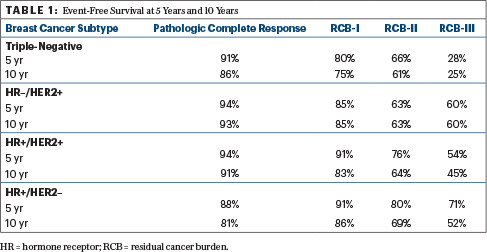
A pathologic complete response (RCB-0) was most likely to be achieved by hormone receptor–negative/HER2-positive patients (69%) and least likely by the hormone receptor–positive/HER2-negative group (11%); the triple-negative group (43%) and hormone receptor–positive/HER2-positive group (38%) fell in between.

The residual cancer burden index values were associated with 5-year and 10-year event-free survival, as shown in Table 1.

Elaborating on what emerged from the four subgroups, Dr. Symmans said that in the hormone receptor–negative/HER2-positive group, the 69% rate of pathologic complete response was “striking” and “illustrates how effective these current [HER2-targeted] treatments are.” The 20% of patients who were classified as RCB-II and RCB-III had significantly worse survival than the others. “It’s a small quintile of patients that’s still at fairly substantial risk.”

He added, “In the hormone receptor–positive/HER2-negative breast cancer group, where there is still a bit of confusion about whether or not chemotherapy can help patients, we see that the extent of residual disease is strongly prognostic.”

In the subgroup with hormone receptor–positive/HER2-negative disease, he continued, “you can see that there’s clearly an effect on prognosis from the chemotherapy. However, the most prognostic aspect of the distribution of response is where there is the most residual disease—the RCB-III and RCB-II groups. Their long-term risk is still continuing beyond 10 years.”

The residual cancer burden index remained independently prognostic in multivariate models adjusting for patient age, grade, and clinical T and N stage at diagnosis. Its value was 1.93 in the triple-negative group, 2.04 in the hormone receptor–negative/HER2-positive group, 1.67 in the hormone receptor–positive/HER2-positive group, and 1.52 in the hormone receptor–positive/HER2-negative group. T4 tumors (and in the triple-negative group, also T3) remained independent predictors of prognosis as well.

Message to the Pathology Community

“Looking ahead, if we can standardize the reporting of residual cancer burden, that will only improve its usefulness in determining long-term prognosis,” Dr. Symmans emphasized. “This study is important in showing the generalizability of residual cancer burden, and it’s of sufficient size to generate the evidence to convince the pathology community to change the way we do things.”

Looking ahead, if we can standardize the reporting of residual cancer burden, that will only improve its usefulness in determining long-term prognosis.
— W. Fraser Symmans, MD

Tweet this quote

Dr. Symmans noted that synoptic reporting is a requirement in oncology, but there is only one synoptic report for invasive cancer—one that is designed for a surgery-first examination. What’s lacking is a neoadjuvant synoptic report that specifically addresses the needs in interpreting a post-neoadjuvant response, he said. “The neoadjuvant model is increasingly related to precision medicine. We are standing at that transition point.” ■

DISCLOSURE: Dr. Symmans holds a patent for the method of calculating residual cancer burden. The residual cancer burden calculator and educational materials are freely and publicly available online. He is also cofounder, owns shares in, and is an unpaid scientific advisor for Delphi Diagnostics.

REFERENCE

Σάββατο 26 Δεκεμβρίου 2020

A NOVEL ANTI-HER2 TREATMENT APPROVED BY FDA

 A new monoclonal antibody that targets HER2+ in breast cancer, margetuximab-cmkb (Margenza), has been approved by the Food and Drug Administration (FDA).

The new drug is indicated for use in combination with chemotherapy for the treatment of patients with metastatic HER2-positive breast cancer who have already received two or more prior anti-HER2 regimens, with at least one for metastatic disease.

Margetuximab-cmkb is also the first HER2-targeted therapy shown to improve progression-free survival (PFS) as compared with the first ever HER2-targeted agent, trastuzumab (Herceptin) in a head-to-head phase 3 clinical trial (known as SOPHIA).

"Early detection and treatment have had a positive impact on the survival of patients with breast cancer, but the prognosis for people diagnosed with metastatic breast cancer remains poor, and additional treatments are needed," said Hope S. Rugo, MD, director of Breast Oncology and Clinical Trials Education, University of California San Francisco Diller Family Comprehensive Cancer Center, San Francisco, California, in a company press release.

"As the only HER2-targeted agent to have shown a PFS improvement vs trastuzumab in a head-to-head phase 3 clinical trial, margetuximab with chemotherapy represents the newest treatment option for patients who have progressed on available HER2-directed therapies," said Rugo, who is an investigator in the SOPHIA trial.

Like trastuzumab, margetuximab-cmkb binds HER2 with high specificity and affinity and disrupts signaling that drives cell proliferation and survival, but margetuximab binds with elevated affinity to both the lower- and higher-affinity forms of CD16A, an Fc gamma receptor important for antibody dependent cell-mediated cytotoxicity against tumor cells, according to the manufacturer.

Details of the Pivotal Trail

The SOPHIA trial was a randomized, open-label phase 3 clinical trial that compared margetuximab-cmkb plus chemotherapy to trastuzumab plus chemotherapy in both arms, in patients with HER2-positive metastatic breast cancer, who had previously been treated with anti-HER2-targeted therapies. All patients in the cohort had previously received trastuzumab, all but one patient had previously also received pertuzumab, and most of the patients (91%) had also been treated with ado-trastuzumab emtansine, or T-DM1.

The trial randomly assigned 536 patients to receive either margetuximab-cmkb A (n = 266) given intravenously at 15 mg/kg every 3 weeks or trastuzumab (n = 270) given intravenously at 6 mg/kg (or 8 mg/kg for loading dose) every 3 weeks in combination with either capecitabine, eribulin (Halaven), gemcitabine, or vinorelbine, given at the standard doses.

As compared with trastuzumab, margetuximab plus chemotherapy led to a significant 24% reduction in the risk for progression or death compared (HR = 0.76).

The median PFS also favored margetuximab (5.8 months vs 4.9 months), as did the overall response rate (22% vs 16%).

The final overall survival analysis is expected in the second half of 2021.

Common adverse events associated with the margetuximab regimen included fatigue/asthenia (57%), nausea (33%), diarrhea (25%), and vomiting (21%). Infusion-related reactions occurred in 13% of patients receiving margetuximab, and almost all were grade 1 or 2, with only 1.5% at grade 3.

The product also carries a boxed warning for left ventricular dysfunction and embryo-fetal toxicity.

For more from Medscape Oncology, join us on Twitter and Facebook


DO NOT USE TEXTURED BREAST IMPLANTS

 Numerous studies have demonstrated that textured breast implants predispose women who undergo breast reconstruction to breast implant-associated anaplastic large-cell lymphoma.

Now, an analysis of new data from a cohort study of 650 women who underwent total mastectomy and breast reconstruction demonstrates a significant association between textured implants, increased distant breast cancer recurrence, and decreased disease-free survival (DFS).

These associations were independent of tumor stage and estrogen receptor (ER) status, according to Sa Ik Bang, MD, PhD, of the Samsung Medical Center, Sungkyunkwan University School of Medicine, Seoul, South Korea, and colleagues.

"We observed a statistically significant association between textured implant use and decreased DFS with an increased risk of recurrence," the investigators write in their article, which was published in JAMA Surgery in October.

"We believe that this study raises an urgent need for further well-designed investigations, which either may refute the findings of this study with more solid evidence and reassure patients or may produce similar results and lead to increased caution in breast cancer surveillance," they write.

The results were "unexpected," the researchers note. Instead of providing evidence that might relieve anxiety for patients with textured implants, "the results may amplify survivors' concern regarding the potentially detrimental implications of a textured implant for oncologic outcomes," they say.

In an accompanying commentary, Michael R. Cassidy, MD, and Daniel S. Roh, MD, PhD, Boston University School of Medicine, Boston, Massachusetts, called the study's preliminary data "both alarming and intriguing" and agreed that "larger, multi-institutional analysis is critical to confirming these findings."

Many reconstructive surgeons have abandoned the use of textured implants, the editorialists note. This study should convince those who haven't to make sure patients are aware of the risks, they emphasize.

"Given the association of textured implants with ALCL [anaplastic large-cell lymphoma], and now the suggestion that they are associated with increased risk for breast cancer recurrence, surgeons who choose textured implants should counsel their patients with breast cancer about their possible consequences," the pair write.

Editorialists Cassidy and Roh express concern that important details were missing from the analysis and presentation. Data on adjuvant endocrine therapy were not included, even though 85% of the cohort had ER-positive breast cancer, they point out.

Similarly, 21% of patients had ERBB2 (formerly, HER2-positive) disease, but no targeted ERBB2 agents were included in the list of adjuvant therapy regimens.

"Therefore, whether the recurrences were associated with inadequate systemic therapy remains unclear," Cassidy and Roh say. "A table that details the history and treatment of the 28 patients with breast cancer recurrence would be helpful in interpreting this study."

Including data from patients who underwent mastectomy for breast cancer recurrence rather than restricting the analysis to data from primary breast cancer cases alone had the effect of "further confounding matters," they add.

Study Details

For the study, Bang and colleagues identified patients with breast cancer who had undergone total mastectomy and immediate two-stage tissue expander/implant reconstruction from a single tertiary referral center database. Patients were categorized into two groups: those who received a smooth implant during reconstruction (39.9%), and those who were given a textured implant (60.1%).

Data analysis showed that 28 women (4.1%) were diagnosed with any type of breast cancer recurrence during the follow-up period. Of these, 23 received a textured implant, and five received a smooth implant.

The 5-year local and regional recurrence-free survival rate was 96.7; the rate did not differ significantly between the two implant groups.

The 5-year DFS was 95.2%, but there was a statistically significant association with lower DFS in the textured-implant group compared with the smooth-implant group after adjusting for ER status and tumor stage (hazard ratio [HR], 3.054; 95% CI; P = .02).

On multivariable analysis, there was a similar textured implant–specific association with worse DFS among patients with ER-positive cancer (HR, 3.130; 95% CI; P = .04) and invasive cancer (HR, 3.044; 95% CI; P = .03). The most pronounced association between textured-implant use and a lower rate of DFS was observed among patients with stage II or III cancer (HR, 8.874; 95% CI, P = .04).

Bang and colleagues note several study limitations. The sample size of the single-institution study was small, and the 4-year follow-up period after implant insertion was inadequate, they say, "especially for ER-positive breast cancer."

Bang and study coauthors as well as editorialists Cassidy and Roh have disclosed no relevant financial relationships.

JAMA Surg. Published online on October 7, 2020. Abstract, Commentary

Παρασκευή 25 Δεκεμβρίου 2020

PEMBROLIZUMAB FOR TNBC

 As reported in The Lancet by Javier Cortes, MD, and colleagues, the phase III KEYNOTE-355 trial has shown that the addition of pembrolizumab to chemotherapy improved progression-free survival among previously untreated patients with locally recurrent inoperable or metastatic triple-negative breast cancer with a PD-L1 expression combined positive score (CPS) of ≥ 10.

The trial supported the November 2020 U.S. Food and Drug Administration accelerated approval of pembrolizumab for use in combination with chemotherapy for treatment of patients with locally recurrent unresectable or metastatic triple-negative breast cancer and tumors expressing PD-L1 with a CPS ≥ 10.

Javier Cortes, MD

Javier Cortes, MD

KEYNOTE-355 Details

The double-blind trial included 847 patients (intention-to-treat population) from sites in 29 countries. They were randomly assigned 2:1 between January 2017 and June 2018 to receive pembrolizumab at 200 mg every 3 weeks plus chemotherapy consisting of physician’s choice of nab-paclitaxel, paclitaxel, or gemcitabine/carboplatin (n = 566) or placebo plus chemotherapy (n = 281). Chemotherapy consisted of nab-paclitaxel at 100 mg/m² on days 1, 8, and 15 every 28 days; paclitaxel at 90 mg/m² on days 1, 8, and 15 every 28 days; or gemcitabine at 1,000 mg/m² plus carboplatin area under the curve = 2 on days 1 and 8 every 21 days. Chemotherapy administration was open label. Pembrolizumab or placebo were continued for up to 35 administrations, with chemotherapy continued at investigator’s discretion or until disease progression or unacceptable toxicity.

The dual primary endpoints were progression-free survival and overall survival assessed in the PD-L1 CPS ≥ 10, CPS ≥ 1, and intention-to-treat populations. The definitive assessment of progression-free survival was done at the current interim analysis; follow-up to assess overall survival is ongoing. A hierarchical testing strategy was used for progression-free survival, with testing done first in the CPS ≥ 10 population (prespecified statistical criterion of α = .00411), then in the CPS ≥ 1 population (α = .00111), and then in the intention-to-treat population (α = .00111).

In the pembrolizumab vs control groups, 220 vs 103 patients had CPS ≥ 10 and 425 vs 211 had CPS ≥ 1. Among all patients, disease status was de novo metastatic in 30% in the pembrolizumab/chemotherapy group vs 30% in the placebo/chemotherapy group, recurrent metastatic in 68% vs 66%, and locally recurrent inoperable in 2% vs 4%.

Progression-Free Survival

At the second interim analysis data cutoff in December 2019, median follow-up was 25.9 months (interquartile range [IQR] = 22.8–29.9 months) in the pembrolizumab group and 26.3 months (IQR = 22.7–29.7 months) in the control group.   

Among patients with CPS ≥ 10, median progression-free survival was 9.7 months in the pembrolizumab group vs 5.6 months in the control group (hazard ratio [HR] = 0.65, 95% confidence interval [CI] = 0.49–0.86, P = .0012; primary objective met). Progression-free survival at 6 and 12 months was 65.0% vs 46.9% and 39.1% vs 23.0%. According to chemotherapy regimen, hazard ratios were 0.57 (95% CI = 0.34–0.95) for nab-paclitaxel, 0.33 (95% CI = 0.14–0.76) for paclitaxel, and 0.77 (95% CI = 0.53–1.11) for gemcitabine/carboplatin. Median progression-free survival among 524 patients with CPS < 10 was 5.8 vs 5.7 months (HR = 0.94, 95% CI = 0.76–1.16).

KEY POINTS

  • Pembrolizumab/chemotherapy significantly prolonged progression-free survival vs placebo/chemotherapy among patients with PD-L1 CPS ≥ 10.
  • The benefit of pembrolizumab increased along with increasing PD-L1 CPS.

Median progression-free survival was 7.6 vs 5.6 months (HR = 0.74, 95% CI =  0.61–0.90, P = .0014; not significant) among patients with CPS ≥ 1, with 6- and 12-month rates of 56.4% vs 46.6% and 31.7% vs 19.4%, and 7.5 vs 5.6 months (HR = 0.82, 95% CI =  0.69-0.97; not tested due to hierarchical testing) among the intention-to-treat population, with 6- and 12-month rates of 55.4% vs 47.8% and 29.8% vs 20.9%.

Median progression-free survival was 6.3 vs 6.2 months (HR = 1.08, 95% CI = 0.77–1.53) among 211 patients with CPS < 1 and 9.5 vs 5.4 months (HR = 0.61, 95% CI = 0.43–0.87) among 204 patients with CPS ≥ 20.

Adverse Events

Grade ≥ 3 treatment-related adverse event rates occurred in 68% of patients in the pembrolizumab group vs 67% of the control group, with the most common in the pembrolizumab group including neutropenia (30% vs 30%), decreased neutrophil count (17% vs 20%), anemia (16% vs 15%), and increased alanine aminotransferase (6% vs 5%). Treatment-related adverse events led to death in two patients (< 1%) in the pembrolizumab group—with causes consisting of acute kidney injury in one and pneumonia in one—and in no patients in the control group.

Immune-mediated adverse events of any grade occurred in 26% vs 6% of patients, with the most common in the pembrolizumab group being hypothyroidism (15%) and hyperthyroidism (5%). Grade ≥ 3 events occurred in 5% vs 0%, with the most common in the pembrolizumab group being severe skin reaction (2%). No patients died due to immune-mediated adverse events.

The investigators concluded, “Pembrolizumab/chemotherapy showed a significant and clinically meaningful improvement in progression-free survival vs placebo/chemotherapy among patients with metastatic triple-negative breast cancer with CPS of 10 or more. These findings suggest a role for the addition of pembrolizumab to standard chemotherapy for the first-line treatment of metastatic triple-negative breast cancer.”

Dr. Cortes, of the International Breast Cancer Center, Quiron Group, Madrid and Barcelona, is the corresponding author for The Lancet article.

Disclosure: The study was supported by Merck Sharp & Dohme Corp, a subsidiary of Merck & Co, Inc. For full disclosures of the study authors, visit thelancet.com.

The content in this post has not been reviewed by the American Society of Clinical Oncology, Inc. (ASCO®) and does not necessarily reflect the ideas and opinions of ASCO®.
Κυριακή 20 Δεκεμβρίου 2020

CHEMOTHERAPY BENEFICIAL IN ELDERLY WITH TNBC

 In a National Cancer Database analysis reported in The Lancet Oncology, Crozier et al found that receipt of neoadjuvant or adjuvant chemotherapy was associated with improved overall survival among women aged 70 or older undergoing surgery for stage I to III triple-negative breast cancer.

Study Details

The analysis included data from the National Cancer Database from women aged 70 or older with surgically treated stage I to III invasive triple-negative breast cancer diagnosed between 2004 and 2014. Patients with T1a N0 M0 disease and those with incomplete data on estrogen receptor, progesterone receptor, or HER2 status were excluded from the analysis.

Patients were categorized into three groups: those who received chemotherapy (chemotherapy group), those who were recommended chemotherapy but did not receive it (recommended/not received group), and those for whom chemotherapy was not recommended and not received (not recommended/not received group).

Overall Survival in Total Cohort

KEY POINTS

  • Receipt of chemotherapy in addition to local therapy was associated with significantly improved overall survival.
  • Benefit was observed in node-negative and node-positive disease and in patients with comorbidities.

A total of 16,602 women were included in the analysis. Of these, 7,485 (46.6%) received chemotherapy; chemotherapy was recommended for but not administered to 2,659 (16.6%); chemotherapy was not recommended for or received by 5,732 (35.7%); and chemotherapy status was not available for 186 (1.2%). Of the patients who received chemotherapy, 5,924 (79.1%) received adjuvant chemotherapy alone; 1,337 (17.9%) received neoadjuvant chemotherapy alone; and 196 (2.6%) received both.

Median follow-up was 38.3 months (interquartile range = 20.7–46.1 months, range = 0–138.0 months).  At data cutoff at the end of January 2016, 3,300 patients (20.5%) had died.

The 5-year overall survival estimate for the entire cohort was 62.3% (95% confidence interval [CI] = 59.7%–64.4%). The 5-year estimates were 68.5% (95% CI = 66.4%–70.6%) in the chemotherapy group, 61.1% (95% CI = 59.0%–63.2%) in the recommended/not received group, and 53.7% (95% CI = 51.8%–55.8%) in the not recommended/not received group (overall P < .0001).

On univariate analysis, hazard ratios were 0.80 (95% CI = 0.73–0.88, P < .0001) for the recommended/not received group and 0.58 (95% CI = 0.54–0.62, P < .0001) for the chemotherapy group vs the not recommended/not received group. There was no apparent correlation of year of diagnosis with overall survival (P = .48).

On multivariate analysis, hazard ratios remained significant at 0.79 (95% CI = 0.71–0.88, P < .0001) and 0.56 (95% CI = 0.51–0.61, P < .0001), respectively. Patients who received radiotherapy (48.7% of entire cohort) also had improved overall survival compared with those who did not receive radiotherapy (50.0% of cohort; HR = 0.62, 95% CI = 0.50–0.79, P < .0001).

Propensity Score–Matching Analysis

A propensity score–matching analysis was performed that included 1,884 patients who received chemotherapy and 1,884 patients in the recommended/not received group, with matching based on age, comorbidity score, tumor grade and size, nodal status, and receipt vs no receipt of radiotherapy.

Estimated 5-year overall survival was 66.8% (95% CI = 65.7%–67.9%) in the chemotherapy group vs 61.8% (95% CI = 60.8%–62.9%) in the recommended/not received group (HR = 0.85, 95% CI = 0.74–0.96, P = .012). The difference remained significant on multivariate analysis (HR = 0.69, 95% CI = 0.60–0.80, P < .0001). There was no clear indication that the benefit of chemotherapy was limited to any age subgroup.

In subset analyses in the propensity-matched cohort, estimated 5-year overall survival among women with node-negative disease (74% vs 66% of cohort, all with tumor size > 5 mm) was 74.4% (95% CI = 72.6%–76.2%) in the chemotherapy group vs 70.7% (95% CI = 68.9%–72.4%) in the recommended/not received group (HR = 0.80, 95% CI = 0.66–0.97, P = .007). Estimated 5-year overall survival among women with node-positive disease was 42.4% (95% CI = 39.9%–44.9%) vs 35.1% (95% CI = 32.6%–37.6%; HR = 0.76, 95% CI = 0.64–0.91, P = .006). Among women with a documented Charlson-Deyo comorbidity score greater than 0 (25% vs 26% of cohort), the hazard ratio was 0.74 (95% CI = 0.59–0.94, P = .013).

On multivariate analysis in the propensity-matched cohort, additional factors significantly associated with overall survival included:

  • Age as a continuous variable (HR = 1.03, P = .0010)
  • Comorbidity score of 1 (HR = 1.54, P < .001) and 2 (HR =1.38, P = .011) vs 0
  • Tumor size > 50 mm vs ≤ 5 mm (HR = 4.38, P = .042)
  • pN1, pN2, and pN3 disease (HRs = 1.92, 3.26, and 5.59, all P < .0001) vs pN0 disease
  • Receipt vs no receipt of radiotherapy (HR = 0.62, P < .0001).

The investigators concluded: “These data support consideration of chemotherapy in the treatment of women aged 70 years or older with triple-negative breast cancer.”

Christopher M. Pezzi, MD, of the Division of Surgery, Baptist MD Anderson Cancer Center, Jacksonville, is the corresponding author for The Lancet Oncology article

LESS WOMEN WITH BREAST CANCER TO RECEIVE AADJUVANT CHEMO-RxPONDER TRIAL

 More women with early-stage breast cancer may safely forgo chemotherapy, suggests an interim analysis that had a median follow-up of 5 years of the large-scale phase 3 RxPONDER trial, presented this week at the San Antonio Breast Cancer Symposium (SABCS) 2020.

The investigators reported that adding chemotherapy to endocrine therapy did not improve outcomes for postmenopausal women with low-risk, node-positive, hormone receptor–positive (HR+), human epidermal growth factor receptor 2–negative (HER2-) breast cancer in comparison to endocrine therapy alone.

These results are akin to those from the TAILORx trial. The results of that trial were first presented in 2018 and have changed practice for women with early-stage disease who have no lymph node involvement.

Clinicians celebrated the new results for women with lymph node–positive disease.

"RxPonder: practice changing!!!" tweeted meeting attendee Sarah Sammons, MD, Duke Cancer Center, Durham, North Carolina.

"Data from RxPonder are the most clinically important this year at @SABCSSanAntonio," tweeted Hal Burstein, MD, Dana Farber Cancer Institute, Boston, Massachusetts, who was not involved in the study.

"This will save tens of thousands of women the time, expense, and potentially harmful side effects that can be associated with chemotherapy infusions," asserted study lead author Kevin Kalinsky, MD, Winship Cancer Institute of Emory University, Atlanta, Georgia, during a meeting press conference.

But the trial, run by the SWOG Cancer Research Network, was not without controversy.

That's because the trial also included premenopausal women whose disease characteristics were the same and who were found to have benefited from chemotherapy.

It was not clear whether the benefit was from chemotherapy's cytotoxicity or its endocrine effects/ovarian suppression (which limits the production of estrogen, a breast cell stimulant) in these young women. But multiple experts asserted that the effect was very likely from ovarian suppression. "There are less toxic ways than chemo to suppress ovarian function," tweeted Tatiana Prowell, MD, Johns Hopkins University, Baltimore, Maryland, who is not a study investigator.

Some experts strongly doubted the findings in premenopausal women.

"I hate to come away with the message that all [low-risk, node-positive] premenopausal patients should get chemotherapy," summarized C. Kent Osborne, MD, Baylor College of Medicine, Houston, Texas, who is co-director of SABCS and was not involved in the study.

RxPONDER will follow patients for 15 years, so additional data and insights will follow, observed SWOG in a press statement.

Women Had Limited Positive Nodes

RxPONDER, or SWOG S1007, involved more than 5000 women who had HR+, HER2- breast cancer with involvement of one to three lymph nodes. The patients' recurrence score was ≤25 on a 21-tumor gene expression assay (Oncotype Dx), which is characterized as low risk.

Approximately 20% of US women with nonmetastatic HR+, HER2- breast cancer present with involvement of one to three lymph nodes, added Kalinsky.

Study participants were randomly assigned to receive either standard chemotherapy plus endocrine therapy or endocrine therapy alone. Follow-up was for a median of 5 years before the current preplanned analysis.

Over a median follow-up of 5.1 years, there were 447 observed invasive disease-free survival (IDFS) events, the primary endpoint, which is 54% of the expected number at final analysis.

Across the whole cohort, adding chemotherapy to endocrine therapy was associated with a significant improvement in IDFS, with a 5-year rate of 92.4% vs 91.0% for endocrine therapy (P = .026).

Among the postmenopausal women, no such improvement was seen. The 5-year IDFS rate was 91.6% with chemotherapy plus endocrine therapy and 91.9% with endocrine therapy alone (P = .82).

Among premenopausal women, there was improvement in IDFS. The 5-year rate was 94.2% with chemotherapy plus endocrine therapy, vs 89.0% for endocrine therapy alone (P = .0004).

These differences were reflected in the results for overall survival. For postmenopausal women, there was a nonsignificant difference in 5-year overall survival rates (96.2% vs 96.1%).

On the other hand, for premenopausal women, there was a significant difference in 5-year overall survival rates (98.6% vs 97.3%; P = .032).

Stratifying patients by recurrence score 0–13 vs 14–25 and by involvement of one vs two to three nodes did not have a major impact on the results, said lead author Kalinsky, who also noted that future analyses will include quality of life and other outcomes.

More About Endocrine Therapy in RxPONDER

Meeting co-director Osborne said that premenopausal women in RxPONDER were "nearly always" prescribed tamoxifen.

However, he observed that the current standard approach to treatment in this age group would be ovarian suppression plus either an aromatase inhibitor or tamoxifen, "both of which have been shown to be superior to tamoxifen alone in this subgroup.

"Since the adjuvant chemotherapy causes ovarian suppression in many premenopausal patients," he said, "these patients then in fact received ovarian suppression plus tamoxifen," rather than tamoxifen alone for the group that did not receive chemotherapy.

Osborne asked a question that came up again and again during the post-presentation discussion: "Is the difference in outcome in this subset due to the endocrine effects of chemotherapy?

"Unfortunately, we may never know the answer to this question," he added.

Kalinsky replied that whether the difference in benefit of chemotherapy in premenopausal women "was a direct benefit, meaning that there's something about the biology difference" between tumors in premenopausal vs postmenopausal women, "or whether this was an indirect effect, meaning impacting rates of amenorrhea...is not specifically how this study was designed."

However, an exploratory landmark analysis at 6 months suggested that the use of ovarian suppression with endocrine therapy did not have an effect on outcomes.

Osborne said he is nevertheless "still skeptical that chemotherapy works differently in premenopausal women.

"Until we show that it's not an endocrine effect...I just can't imagine why that group of patients, even the ones with very low Oncotype [score], would have a different response to chemotherapy."

He added: "If I can think of a rationale...I would believe it, but right now, I'm a little bit skeptical."

Virginia Kaklamani, MD, of the UT Health San Antonio Cancer Center, San Antonio, Texas, who is a meeting co-director, said that she wanted to "second that.

"I honestly think that this is an OFS [ovarian function suppression effect] that we are seeing. We have several clinical trials that have been done looking at ovarian function suppression vs not...showing that [it] can help as much as chemotherapy."

Kaklamani continued: "Unfortunately, the arms to those trials were not perfect for now, and this is going to be an unanswered question until we have a large trial comparing OFS to chemotherapy."

The study was sponsored by the National Cancer Institute and in part by the Susan G. Komen for the Cure Research Program, the Hope Foundation for Cancer Research, the Breast Cancer Research Foundation, and Exact Sciences. Kalinsky, Osborne, and Kaklamani report financial ties to multiple pharmaceutical companies.

San Antonio Breast Cancer Symposium (SABCS) 2020: Abstract GS3-00. Presented December 10, 2020.

For more from Medscape Oncology, join us on Twitter and Facebook.

CTCs TO GUIDE BREAST CANCER THERAPY-NOT YET

 Trial results suggest circulating tumor cell (CTC) counts may be a reliable biomarker for guiding the choice of first-line treatment in patients with hormone receptor–positive, HER2-negative metastatic breast cancer, investigators wrote in JAMA Oncology.

However, authors of a related editorial suggested CTC counts are not adequate for guiding treatment choice in this population.

In a phase 3 trial, investigators compared the use of CTC counts and the use of clinical factors to guide the decision between chemotherapy and endocrine therapy. Results showed similar progression-free survival (PFS) and overall survival (OS) with both methods but more chemotherapy use with the CTC method.

"The results of this trial demonstrate the reliability and clinical utility of CTC count to guide the choice between single-agent endocrine therapy and chemotherapy as first-line treatment," but "at the cost of a higher proportion of patients treated with chemotherapy," study author François-Clement Bidard, MD, PhD, of Institut Curie in Saint-Cloud, France, and colleagues wrote.

The investigators explained that endocrine therapy is the preferred first-line treatment option in this patient population, but chemotherapy is used when women are in visceral crisis, with rapidly progressive, symptomatic disease. The decision usually rests on clinical factors, such as tumor subtype and performance status, but there's interphysician variability.

The team hoped to find a "more reliable, standardized, and reproducible" biomarker to help remove some of the uncertainty from the situation. They tested CTC count, a well-established prognostic indicator of PFS and OS, as a candidate.

Study Results

The trial included 755 patients with hormone receptor–positive, HER2-negative breast cancer in the per-protocol population. The patients' median age was 63 years (range, 30-88 years).

Among the 377 patients randomized to the CTC arm, those with counts at or above 5 CTCs per 7.5 mL received chemotherapy, while those with a lower count received endocrine therapy.

The 378 patients in the standard-care group received endocrine therapy or chemotherapy based on provider choice guided by clinical factors.

Chemotherapy was given to 37% of patients in the CTC arm and 27% of those in the standard arm.

The median PFS was 15.5 months in the CTC arm and 13.9 months in the standard arm, which meant the primary endpoint of noninferiority was met (hazard ratio, 0.94; 90% confidence interval, 0.81-1.09).

Age older than 60 years was the only baseline characteristic associated with better PFS with CTC-driven decision-making. This may be because of the greater "use of endocrine therapy as the clinically favored treatment, whatever the other clinicopathologic characteristics," in older subjects, the investigators wrote.

As with PFS, the median OS was similar between the study arms – 47.3 months in the CTC arm and 42.8 months in the standard arm (HR, 0.91; 95% CI, 0.71-1.16).

"Not Good Enough"

The investigators behind this study had "a worthy goal," according to authors of a related editorial.

Without "predictive biomarkers, we are left with our clinical knowledge, experience, and intuition. Patients are left with uncertainty, doubt, and fear," Tarah Ballinger, MD,, of Indiana University, Indianapolis, and colleagues wrote in the editorial.

However, the editorialists had concerns about the findings. For one thing, the investigators hypothesized that relying on CTC would lead to a deescalation from chemotherapy to endocrine therapy, but use of chemotherapy was actually 10% higher in the CTC arm.

"Adding to or replacing the parameters we use to make a clinical decision should help us improve the lives of patients. ... We should demand an improvement in outcomes before accepting a strategy that exposes more patients to more toxic therapy. Not worse simply is not good enough," the editorialists wrote.

In addition, the trial was completed before CDK4/6 inhibitors became a standard add-on with endocrine therapy for hormone receptor–positive, HER2-negative patients.

"The overall response rate to CDK4/6 inhibitor therapy is higher than with traditional chemotherapy, and several randomized trials have failed to show a survival benefit of upfront chemotherapy compared with CDK4/6 inhibitor use. ... Thus, it is even less likely that we can assume that baseline high CTC count corresponds to a need for chemotherapy in a modern treatment landscape that offers more patients more benefit from hormone therapy," Ballinger and colleagues wrote.

The editorialists concluded that CTC count "alone at baseline primarily reflects disease bulk, much like anatomic staging, rather than disease biology. As treatments become more rooted in our knowledge of breast cancer biology, decisions based on disease bulk are decidedly out of place."

Perhaps a better use, they suggested, is for treatment personalization. For instance, patients with persistently elevated CTCs despite standard approaches could consider trials of novel targeted therapies, or CTCs could be sequenced to identify actionable molecular targets, achieving a "clinical utility that merely counting CTCs lacks," the editorialists wrote.

This study was funded by the Institut Curie, the French National Cancer Institute, and Menarini Silicon Biosystems, the maker of the CTC assay used in the trial. The investigators disclosed relationships with Menarini and many other companies. Ballinger receives honoraria from Medscape, which is owned by the same company as this news organization.

SOURCE: Bidard FC et al. JAMA Oncol. 2020 Nov 5. doi: 10.1001/jamaoncol.2020.5660.

PREGNANCY SAFE AFTER BREAST CANCER TREATMENT

 Breast cancer survivors are less likely to get pregnant and have higher risks of some delivery and fetal complications, according to a meta-analysis reported at the 2020 San Antonio Breast Cancer Symposium.

However, the data also showed that pregnancy does not increase the risk of cancer recurrence.

"With the availability of more effective anticancer treatments, survivorship and addressing the treatments' potential long-term toxicities has gained substantial attention," said study investigator Matteo Lambertini, MD, PhD, of University of Genova (Italy) – IRCCS Policlinico San Martino Hospital.

"Returning to a normal life after cancer diagnosis and treatment should be considered, in the 21st century, as a crucial ambition in cancer care," Lambertini added. "In patients diagnosed during their reproductive years, this includes the possibility to complete their family planning. Due to the constant rise in age at first pregnancy over the past years, many women are diagnosed with breast cancer before completing their reproductive plans."

In that context, certain cancer treatments have the potential to reduce fertility. In addition, many women need prolonged hormone therapy, and conception is contraindicated while they are receiving it.

Study Results

Lambertini and colleagues performed a meta-analysis using data from 39 studies that included a total of 114,573 breast cancer patients and 8,093,401 women from the general population.

Results showed that breast cancer survivors were much less likely than women in the general population to become pregnant (relative risk, 0.40; P < .001).

However, "the majority of the studies included in our meta-analysis did not capture the information on how many women tried to get pregnant," Lambertini cautioned.

In the few studies that did, more than half of women trying to conceive did become pregnant, and most of them were able to do so naturally, without need for assisted reproductive technologies.

On the flip side, analyses also showed that pregnancies occurred in some women who did not want to conceive, underscoring the importance of comprehensive oncofertility counseling that addresses not only fertility preservation, but also contraception, Lambertini said.

Among women who became pregnant, breast cancer survivors did not have higher odds of spontaneous abortion or complications such as preeclampsia, and their infants were not significantly more likely to have congenital abnormalities.

However, the breast cancer survivor group did have higher odds of cesarean birth (odds ratio, 1.14; P = .007), low birth weight (OR, 1.50; P < .001), preterm birth (OR, 1.45; P = .006), and infants small for gestational age (OR, 1.16; P = .039).

In stratified analysis, the higher risk of having an infant with low birth weight was significant only for women who had received chemotherapy, and the higher risk of having an infant small for gestational age was significant only for women who had received chemotherapy or who had a late pregnancy (more than 2 years to 5 years after cancer diagnosis).

Among breast cancer survivors, those who became pregnant actually had lower risks of disease-free survival events (hazard ratio, 0.73; P = .016) and death (HR, 0.56; P < .001). Findings were similar in the subset of studies that adjusted for the so-called healthy mother effect.

Pregnancy did not significantly affect disease-free survival among women with hormone receptor–positive disease and appeared protective among women with hormone receptor–negative disease (HR, 0.72).

Pregnancy also appeared safe in terms of overall survival, irrespective of survivors' BRCA status, nodal status, receipt of chemotherapy, pregnancy outcome (completed vs. abortion), and pregnancy interval.

This study was limited by the lack of patient-level data and by the fact that most of the included studies had a retrospective design, Lambertini acknowledged.

Close Monitoring, Early Discussions Are Key

"Results of this meta-analysis provide reassuring, updated evidence on the feasibility and safety of conceiving in young women with prior breast cancer diagnosis. They provide crucial information for improving the oncofertility counseling of young breast cancer patients, helping them and their treating physicians in making evidence-based decisions on future family planning," Lambertini commented.

"The higher risk of delivery and fetal complications…calls for ensuring a closer monitoring of these pregnancies," he added. "The lack of detrimental prognostic effect of pregnancy after breast cancer following appropriate treatment and follow-up strongly voices the need for a deeper consideration of patients' pregnancy desire as a crucial component of their survivorship care plan and wish to return to a normal life."

"The findings provide further support regarding the safety of pregnancy following a breast cancer diagnosis," agreed Halle Moore, MD, of Cleveland Clinic Taussig Cancer Institute in Ohio, who was not involved in this study.

"I would add that we still have a lot to learn about optimal timing of pregnancy with respect to breast cancer treatment for women with hormone-sensitive breast cancer treated with endocrine therapy," she said.

The study's results serve as a reminder that providers should be routinely discussing future pregnancy wishes and fertility preservation options with breast cancer patients at the time of initial diagnosis, Moore said.

"The earlier we identify an interest in future fertility, the more we can do to improve the chances for a successful pregnancy outcome," she elaborated. "It is important to assess interest in future pregnancy as soon as possible when a young woman is diagnosed with breast cancer, as fertility preservation options are most likely to be successful when applied prior to chemotherapy or hormonal treatment for breast cancer."

"The findings also suggest that involvement of a high-risk obstetrics team should be considered for pregnant breast cancer survivors," Moore noted.

This research was funded by the Italian Ministry of Health and the Italian Association for Cancer Research. Lambertini and Moore disclosed no conflicts of interest. Eva Blondeaux, MD, of University of Genova – IRCCS Policlinico San Martino Hospital, who presented this research at the meeting, disclosed no conflicts as well.

SOURCE: Blondeaux e et al. SABCS 2020, Abstract GS3-09.

This article originally appeared on MDedge.com, part of the Medscape Professional Network.